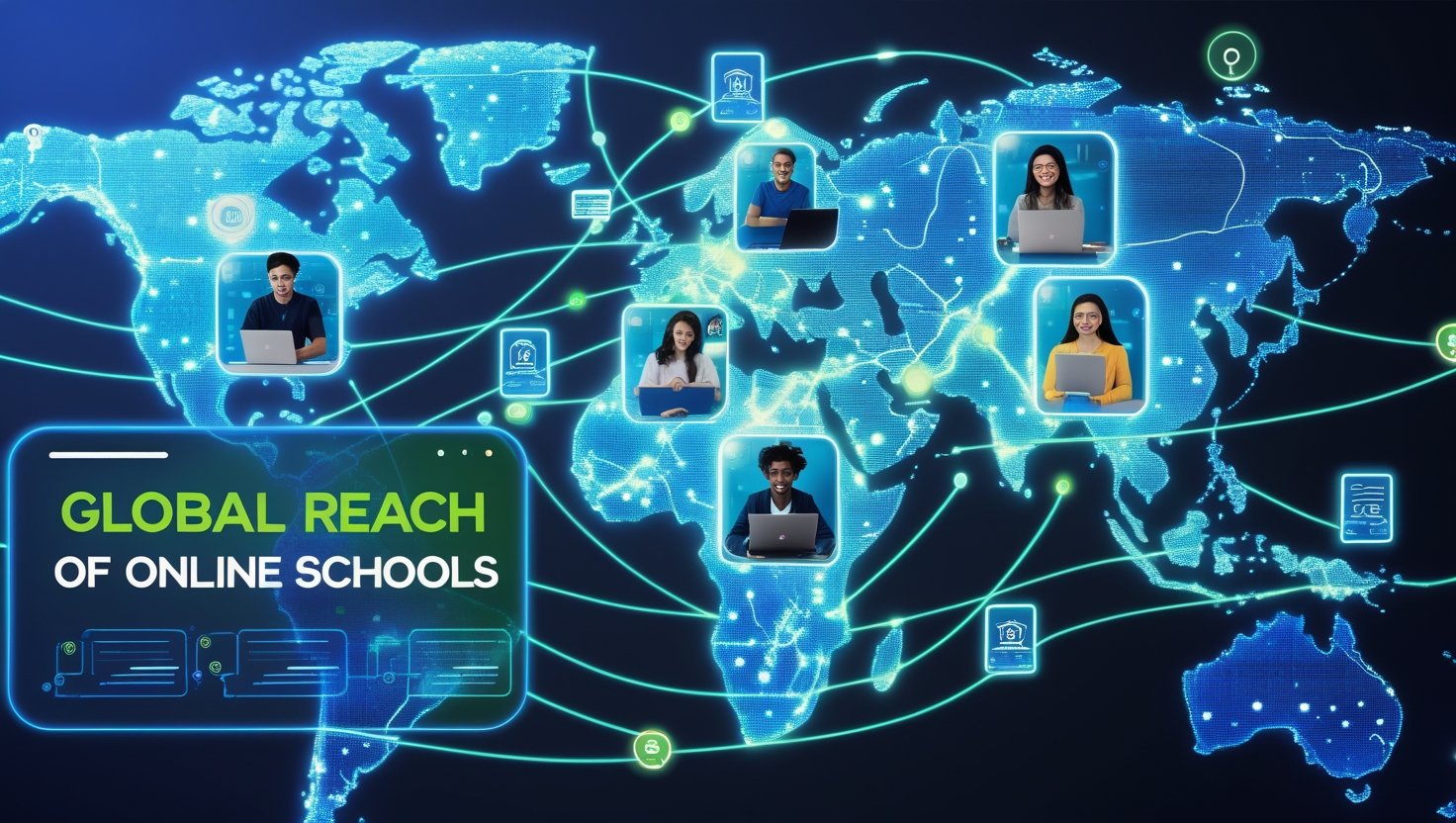
Online education has opened the doors of learning for students from across the world. Earlier, studies were only at the local or national level, but now, learning can be acquired from any country’s school or university, sitting in any corner. This has become possible due to digital platforms and the internet, where the concept of physical boundaries has ended. Earlier, students had to go to another city or country to get admission in a good institute, and this involved a lot of visas, travel expenses, and time, but online schools have removed all these obstacles. Now, a Pakistani student can easily join any online program in America or the UK and get the same standard education as at home. You can achieve this sitting at home. This global access not only provides convenience but also uplifts the quality standards of society.
In this system everyone gets equal opportunity where gender, location or income level does not matter This global reach of online schools is no less than a revolution where every student has become a part of a digital classroom and every teacher can share his/her content worldwide This change has made education inclusive and has allowed students to develop a global mindset This is not just an advantage of technology but a new door of society where knowledge is not confined within any boundaries.
Diverse Student Populations – Learning in a Global Classroom:
When we talk about online schools, the first unique element is their global and diverse student population. In online classrooms, students are from different countries whose cultures, languages, and backgrounds are different. A Pakistani student is sharing a class with a South African or Japanese student. This environment becomes a great learning opportunity for students where they not only learn the course content but also understand the way people think and understand people from all over the world. Teachers say that when students from different cultures interact, they develop tolerance, empathy, and open-mindedness. Earlier in traditional classrooms, you had students from your city or neighborhood.
There used to be people from the same country but now online classrooms are like a mini world where every student shares his/her perspective and a strong human connection is formed despite everything being virtual It also improves the communication skills of students from a diverse population and makes them global citizens For many students, this is the first time they interact in another language or accent but gradually they learn to adjust and their confidence increases This aspect of online schools is very powerful because it prepares students for the international work environment of the future where cultural intelligence and adaptability will be very essential skills This diversity not only exciting the classrooms it does not make any difference but it also brings depth to the thinking of the students.
Time Zones and Flexible Scheduling – Learning Anytime, Anywhere:
One of the strongest advantages of online schools is their flexibility and time zone-friendly scheduling. When students from all corners of the world join the same course or program, the time zone issue is natural. But online education platforms have found a smart solution to this problem. Flexible class timings and recorded lectures have made this system accessible to every student. If a student is in Pakistan and his class timings are according to the time zone of the USA, he can watch the recorded lecture and study according to his own time. This does not disturb the personal routine of the student, and he can learn at his own pace. For many students who do part-time jobs or take care of household chores, this is very useful.
This flexibility is very valuable; it does not create a burden of education; rather, it becomes a support system. Teachers also record and upload their lectures, which students can watch and understand multiple times. Live sessions are also repeated according to the time zone so that every student gets an equal chance. This is the reason why online schools are becoming so successful on a global level, because they have broken the time barriers and given every student an opportunity to study according to their local time. This flexible approach keeps the motivation of students alive and makes them disciplined so that they follow their routine as per their convenience and remain consistent.
Cross-Cultural Communication and Collaboration:
Another very important aspect of online schools is cross-cultural communication and collaboration. When students from different countries are on the same platform, they interact naturally, and this interaction gives them a chance to understand the cultural norms and values of each other. When a Chinese student works on a project with a Brazilian student, he not only completes the assignment but also learns communication skills, empathy, and teamwork. Teachers have observed that in cross-cultural groups, students participate more actively and come up with new ideas. This kind of collaboration is eye-opening for students, where they step out of their comfort zone and talk to new people.
They develop cultural sensitivity. In this process, many misunderstandings also occur, like language barrier or cultural misinterpretation, but these moments give them an opportunity to learn and grow. This collaboration prepares them for an international team environment where they can work in any country in the future. In online classrooms, teachers encourage group assignments and discussions so that students learn not just academic knowledge but also interpersonal and intercultural skills. In today’s time, these skills are very valuable for any job or career. Therefore, online education has become a means of not just knowledge transfer but also character and mindset development.
Technology as a Bridge – Tools Enabling Global Learning:
The entire system of online education is based on technology, and this technology is the bridge that connects students from all over the world to each other. In this, communication tools like Zoom, Microsoft Teams, or Google Meet play a central role, with the help of which teachers and students interact in real-time. Apart from this, Learning Management Systems like Moodle, Google Classroom, or Canvas have made it very easy to organize course material and track assignments. Many schools use digital whiteboards, screen sharing, and video presentations to make lectures engaging and understandable.
Teachers have made learning interactive with tools like Padlet, Kahoot, and Quizizz, which increases the interest of students and motivates them to participate. Using these tools, teachers also provide asynchronous learning options for students in different time zones, where they can complete the course as per their timing Mobile apps and cloud storage have given every student access to access their data and course files from anywhere, wherever they are Apart from this, translation and speech-to-text tools have reduced the language barrier, which has proved helpful for international students This role of technology is not just limited to connectivity, rather it personalizes and makes education inclusive Every student chooses tools as per his/her learning style and grows at his/her own pace Therefore, technology has become the backbone of online education, which is evolving every day.
Conclusion:
When we talk about the global reach of online education, it is clear that it is not just a temporary system but has become a permanent feature of the future. It has given new dimensions of access, equality, and cultural exchange to the students of the world, where a student can get an education from any international institute, sitting in any country, and can pursue their dreams. In this process, students have not only gained academic knowledge but also learn skills like communication, adaptability, and teamwork, which will be useful in their personal and professional life.
Teachers, researchers, and policymakers say that to make global online education even better, infrastructure and digital training will have to be improved significantly. Their vision is that of the future. I have come up with a balanced hybrid model of online learning and traditional learning where flexibility and real interaction are beneficial for both. Both students and teachers say that if proper support and tools are given, then this model can work at every level and can be made accessible to students of every region. The conclusion is that the digital bridge built by online education has freed knowledge from every boundary, and it is not just a system but has become a global community where every student and teacher is a part of a universal classroom, and with this model, the future is being prepared.
FAQs:
Q1: How do online schools provide global access to education?
Online schools allow students from any country to join classes from schools and universities around the world using the internet. Students no longer need to travel abroad or deal with visas and high costs. They can study at home and still get quality education from international institutions.
Q2: What are the benefits of learning in a globally diverse online classroom?
Online classrooms bring together students from different countries and cultures. This helps students learn not just academic content but also understand different ways of thinking. It builds tolerance, open-mindedness, and communication skills, making students ready for a global work environment in the future.
Q3: How do online schools handle time zone differences for international students?
Online schools offer flexible schedules, recorded lectures, and repeat live sessions. This means students can study at a time that suits their own local schedule. It helps students balance studies with personal or work responsibilities and keeps them motivated to stay consistent in their learning.
Q4: What role does technology play in connecting students globally?
Technology is the backbone of global online education. Tools like Zoom, Google Meet, Google Classroom, and learning apps make it easy to teach, learn, and collaborate. Students can access materials from anywhere, work on group projects, and even overcome language barriers using translation tools.
Q5: Why is global online education considered the future of learning?
Global online education offers freedom, equality, and cultural exchange. It helps students learn important life skills like adaptability and teamwork. Experts believe that with better support and training, a hybrid model combining online and in-person learning will be ideal for students everywhere in the future.